
Our Technology
Embodied AI
Embodied AI is artificial intelligence that perceives, models, and acts in the physical world through a body. Humanoid robots, autonomous vehicles, drones, industrial robots. Machines that don't just compute about the world, but operate inside it.
It is the agent subset of Physical AI. Physical AI is the broad umbrella: any AI that touches the physical world, from smart sensors to factory analytics. Embodied AI is narrower and harder. These are agents with bodies, running frontier models onboard, making decisions where the cost of being late is measured in physical consequences, not retries.
That distinction is not semantic. It defines a compute workload unlike anything existing silicon was built to run.
Two Compute Regimes
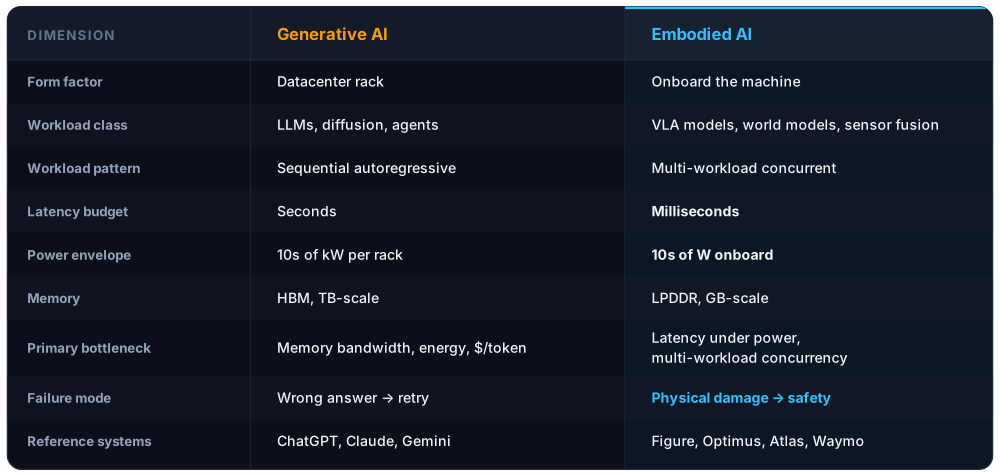
The last decade of AI silicon was built for one regime: generative AI in the datacenter. Racks of GPUs, tens of kilowatts, terabytes of HBM, latency budgets measured in seconds, and a failure mode where a wrong answer simply means asking again.
Embodied AI is the other regime. The model runs onboard the machine. The power envelope is tens of watts, not tens of kilowatts. The latency budget is milliseconds, not seconds. And the failure mode is not a retry. It is a dropped object, a missed obstacle, a safety event.
Why the Workload Breaks Existing Silicon
Four structural constraints separate Embodied AI from every workload that today's silicon categories were designed to serve.
- Hard real-time latency ceilings
An embodied agent operates under Time-to-Learning (TTL) deadlines. These are hard thresholds, not curves. Below the threshold, the action succeeds. Above it, the action fails, regardless of how accurate the model's answer eventually is. A balance correction that arrives 40 milliseconds late is not a slower answer. It is a fall. Throughput-optimized architectures, built to maximize tokens per second, have no mechanism to guarantee a deadline. - Concurrent heterogeneous workloads
A humanoid robot is not running one model. It is simultaneously running cognitive reasoning, world-model rollout, vision encoding, reactive motor control, and sensor fusion. Each has a different latency class, and each contends for the same compute and memory. Monolithic GPU architectures execute one workload pattern well. They cannot schedule five distinct workload classes against five distinct deadlines on one die without the slowest deadline being missed. - Power and cost as unit economics
In the datacenter, power is an operating expense amortized across millions of queries. Onboard a machine, every watt comes out of battery life, payload, and bill of materials. For a humanoid that has to be sold at a price point, compute efficiency is not an optimization. It is the difference between a product and a prototype. The binding constraint is not FLOPS. It is useful intelligence delivered per watt. - A converging model stack
This category now has named workloads: VLA models like π0.7 and Helix, foundation models like GR00T, and world models that predict physical outcomes before acting. These architectures are converging fast enough to design silicon against, something that was not true two years ago. The software has arrived. The silicon has not.
The Fourth Silicon Categories
Datacenter silicon optimizes throughput at kilowatt scale. Automotive silicon optimizes functional safety for a fixed, certified workload. Embedded silicon optimizes cost and power for narrow, static tasks. Each category exists because its constraints diverged far enough from the others that adapted silicon lost to purpose-built silicon.
Embodied AI has now diverged on all four constraints at once. Today it is served by adaptation: datacenter GPU architectures repackaged into robot-sized modules. Adapted silicon runs the workload. It does not run it within the latency, power, and concurrency envelope that makes embodied products viable. Every prior silicon category began exactly this way. Served by adaptation, until purpose-built silicon defined the category.
What Tayen Builds
Tayen builds Frontier Silicon for Embodied AI: the processor architected from the ground up for concurrent world-model, perception, and control workloads under hard real-time deadlines and onboard power envelopes. Native to today's frontier models. Designed at the speed of AI.
The autonomy economy needs its own silicon. Tayen builds it.